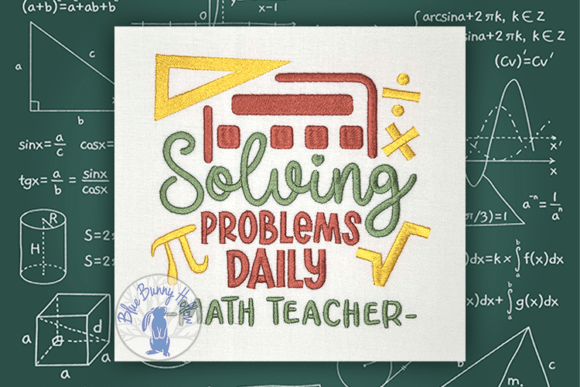
Solving Problems Daily - Math Teacher: A Meaningful Tribute for Educators
Mathematics is often misunderstood as a subject of rigid numbers and abstract formulas, but at its core, it is the study of logic, patterns, and problem-solving. For educators who dedicate their careers to guiding students through these complexities, the role extends far beyond the textbook. The Solving Problems Daily - Math Teacher embroidery design captures this essence perfectly. It is not just a phrase; it is a recognition of the daily mental gymnastics teachers perform to help young minds develop critical thinking skills that last a lifetime. Whether you are looking for a heartfelt gift for a mentor, a way to decorate your own classroom, or a unique item for your teacher appreciation event, this design offers a professional yet personal touch.
However, selecting and applying an embroidery design involves more than just picking a pretty image. Many buyers overlook the technical nuances that determine whether a project turns out crisp and professional or messy and disappointing. Understanding the specifics of machine embroidery files, fabric compatibility, and design scaling can save you from wasted materials, ruined projects, and frustration. Let’s explore how to make the most of this specific design while avoiding common pitfalls that often trip up even experienced crafters.
Understanding the Value of the Design
The Solving Problems Daily - Math Teacher motif features a thoughtful message encircled by mathematical symbols. This visual arrangement creates a sense of unity and focus, mirroring the way math connects various concepts in the real world. It serves as a constant reminder that the skills taught in the classroom—logic, patience, and analytical reasoning—are applied every single day, both inside and outside the school walls.
People are drawn to this design because it bridges the gap between professional appreciation and personal sentiment. Unlike generic "Best Teacher" gifts, this design speaks directly to the unique challenges and rewards of teaching mathematics. It validates the hard work of explaining complex equations and celebrating those "aha!" moments when a student finally grasps a difficult concept. When stitched onto high-quality materials, it becomes a durable keepsake rather than a disposable token.
Common Mistakes in File Selection and Compatibility
One of the most frequent errors creators make is assuming that all digital embroidery files are interchangeable. The Solving Problems Daily - Math Teacher design typically comes with multiple file formats, such as .PES, .DST, .JEF, and others. While this variety is beneficial, it requires careful attention. Using a file format that your specific embroidery machine does not support will result in immediate failure before the needle even touches the fabric.
Furthermore, there is a misunderstanding regarding resolution and stitch count. Some users download low-resolution previews or assume that a small file size indicates a simpler, faster stitch. In reality, intricate designs like the one featuring circling math symbols require a sufficient stitch count to render clearly. If the stitch density is too low, the text may appear jagged, and the symbols might look incomplete. Conversely, if the design is scaled up without adjusting the stitch parameters, the fabric can pucker, leading to a distorted final product.
How to avoid this:
- Always verify the exact list of included file formats against your machine's manual before purchasing.
- Check the stitch count details provided by the seller. A higher stitch count generally ensures better definition for text and small symbols.
- If you plan to resize the design, ensure your embroidery software allows for proper scaling without distorting the aspect ratio of the text or symbols.
Fabric Choice and Stabilizer Errors
Another area where results often suffer is the selection of the base material. The Solving Problems Daily - Math Teacher design is versatile enough for tote bags, classroom décor, and apparel, but each surface demands a different approach. A common mistake is treating a heavy canvas tote bag the same as a thin cotton t-shirt. Without the correct stabilizer, the tension from the needle can cause the fabric to warp, especially around the circular elements of the design.
For example, stitching this design on a flimsy tote bag without a cut-away stabilizer can lead to sagging or tearing over time. Similarly, using a water-soluble stabilizer on a thick fleece jacket might not provide enough support, resulting in uneven stitches. The complexity of the text and the surrounding symbols means that the hoop must be tight and the backing secure to prevent shifting during the stitching process.
Better approaches include:
- Using a tear-away stabilizer for stable fabrics like denim or heavy canvas.
- Opting for a cut-away stabilizer for stretchy fabrics like knits or fleece to maintain shape.
- Testing the design on a scrap piece of the actual fabric first to check thread tension and stabilizer effectiveness.
Thread Quality and Color Matching
The longevity and visual appeal of your project also depend heavily on thread quality. Cheap threads are prone to breaking, which interrupts the stitching sequence and can leave unsightly gaps in the text or symbols. Additionally, color matching is often overlooked. The math symbols and the text should contrast well with the background fabric to ensure readability. A dark grey thread on a black tote bag, for instance, renders the message invisible.
To ensure a professional finish, invest in high-quality polyester or rayon threads designed for machine embroidery. These threads have a sheen that enhances the visibility of the text and symbols. When choosing colors, consider the environment where the item will be used. A classroom banner might benefit from bold, primary colors, while a gift for a senior teacher might look more elegant in muted tones or metallics.
Evaluating the Purchase Before You Commit
Before downloading or buying the Solving Problems Daily - Math Teacher design, take a moment to evaluate the source. Reputable sellers provide clear previews, detailed specifications, and customer support. Be wary of listings that lack stitch-out photos or do not specify the maximum and minimum recommended sizes. These details are crucial for ensuring the design looks good on your intended project.
Also, consider the licensing terms. If you intend to sell items embroidered with this design, such as custom tote bags for a fundraiser or merchandise for a school store, you must ensure the license permits commercial use. Many free or low-cost designs are restricted to personal use only. Ignoring these terms can lead to legal issues and reputational damage for small business owners or educators running fundraising initiatives.
Practical Application Tips for Success
Once you have the correct file and materials, the execution phase requires patience. Hoop the fabric tightly, ensuring there is no slack. If you are working on a tote bag, place a firm object inside the bag to create a flat surface for hooping. This prevents the needle from hitting the bottom of the bag and ensures even tension.
Start with a test run on a similar fabric scrap. This step allows you to adjust thread tension and speed settings before committing to the final piece. Pay close attention to the start and stop points of the design. Proper trimming of jump stitches between the text and the symbols ensures a clean look. Finally, after the stitching is complete, remove the stabilizer carefully according to its type (tear or wash away) to reveal the crisp details of the math symbols and the inspiring message.
By paying attention to these details, you transform a simple digital file into a high-quality tribute. The Solving Problems Daily - Math Teacher design is more than just a pattern; it is a tool for honoring the dedication of educators. With the right preparation and technique, your finished project will stand as a lasting symbol of appreciation, ready to be displayed proudly in a classroom or carried daily by the teacher who inspires the next generation of problem solvers.